


%20(1).png)


- The best compliance management software automates evidence collection, control monitoring, and audit reporting so teams spend less time on manual tasks and more time on strategy.
- Most platforms support major frameworks (SOC 2, ISO 27001, HIPAA, GDPR, PCI DSS) out of the box; the real differentiator is how many, and whether custom frameworks are included at no extra cost.
- Scrut, Vanta, Drata, Sprinto, OneTrust, Optro (formerly AuditBoard), and Hyperproof are the seven tools reviewed here.
- Key selection criteria: framework breadth, integration depth, risk module quality, audit collaboration features, and total cost of ownership.
Regulatory requirements keep multiplying across geographies and industries. A single growing company now routinely juggles SOC 2, ISO 27001, GDPR, HIPAA, and PCI DSS at the same time, often on overlapping timelines.
The problem is how most teams still manage it: spreadsheets, siloed documentation, and manual workflows that break the moment a control changes or an auditor asks a new question.
According to PwC’s Global Compliance Survey 2025, which surveyed more than 1,800 compliance and risk leaders across 63 territories, organizations that invested in compliance technology report faster identification and response to compliance issues (53%) and increased productivity and cost savings (43%).
The manual approach keeps teams permanently reactive: organizing evidence, chasing policy updates, tracking risks, and scrambling the week before every audit.
This guide is written for the people who own that work: GRC Managers, Compliance Managers, Security Managers, founders, CTOs, and Heads of Engineering at scaling companies. If compliance has become a recurring fire drill for your team, the right software turns it into a background process instead of a quarterly crisis.
Below, we break down what to look for in a compliance platform, compare the seven tools worth evaluating in 2026, and give you a buyer's framework you can use in your next vendor demo.
What to look for in compliance management software
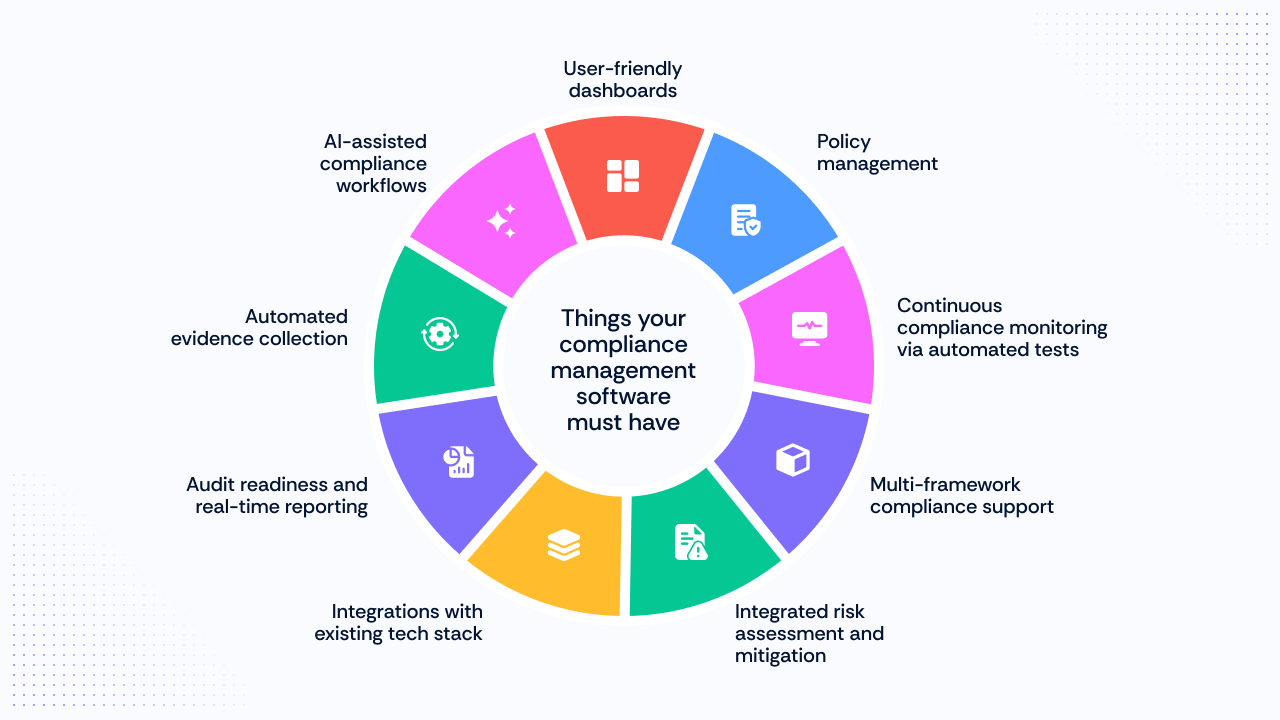
Before you shortlist anything, clarify what matters for continuous compliance, faster audits, and minimal manual overhead. These capabilities separate a platform that saves your team time from one that just reorganizes busywork.
1. User-friendly dashboards
A real-time view of your organization's compliance posture is non-negotiable. Dedicated dashboards for risk, compliance, audit, and people give you a single place to see what is pending, what is overdue, and what needs attention before an audit window opens.
Good dashboards go beyond a status overview. The dashboards worth paying for do three things:
- Advanced filtering to segment compliance data by framework, department, or progress status, so you can drill into a specific area instead of reading a wall of data.
- Metric-based graphs that surface control status, task completion, and audit progress at a glance.
- Jobs-to-be-done views with pending and overdue indicators, plus highlights for upcoming audits and deadlines.
2. Policy management
Building policies for multiple frameworks from scratch is slow and error-prone. Good compliance software ships with pre-built, customizable policy templates you can adapt and enforce quickly, covering data processing, privacy, and cybersecurity.
The minimum viable policy module includes:
- 100+ pre-built policy templates aligned with major regulations.
- A centralized policy repository with version control.
- Automated policy distribution with employee acceptance tracking.
- Workflows for managing policy approvals and exceptions.
This streamlines the whole policy lifecycle, keeps you consistent across frameworks, and reduces legal exposure.
3. Continuous compliance monitoring via automated tests
Compliance is not static. Controls break, fail silently, or get bypassed. Your platform should test controls on a recurring basis to confirm they are working as intended.
Increasingly, modern platforms use agentic AI to detect evidence gaps before auditors ever see them, flagging a broken or stale control while you can still fix it quietly.
Core capabilities to confirm:
- Automated controls testing based on predefined logic (for example, checking whether MFA is enabled or access logs are being collected).
- Real-time monitoring of control status and evidence freshness.
- Scheduled or automatic alerts for failed controls, missing evidence, or policy changes, routed to the right owners.
- Built-in remediation workflows that suggest fixes and let you assign and track corrective actions.
4. Multi-framework compliance support
Most organizations pursue a mix of certifications and regulations at once. Without centralized management, that becomes fragmented and redundant. A strong platform:
- Supports pre-built, up-to-date templates for major frameworks.
- Lets you map one control to multiple frameworks.
- Surfaces overlapping control, testing, and documentation requirements to reduce duplicated effort.
- Tracks test and evidence reuse across frameworks.
- Handles exceptions and deviations per framework with documented rationale.
One distinction buyers miss: custom framework support. Not every platform includes it, and some charge extra. If you expect to add a regional or customer-specific framework, confirm whether that is included before you commit.
5. Integrated risk assessment and mitigation
Risk is not separate from compliance. It is central to it. Organizations carry IT, operational, legal, reputational, and third-party risk at once, and managing all of that manually leaves gaps.
Your platform should give you centralized visibility into internal, vendor, and environmental risk, and tie each risk directly to your controls.
In practice, your risk module should do all of the following:
- Maintain a structured risk register with a pre-built risk library and fields for capturing vendor-specific information.

- Provide real-time dashboards and heat maps for risk status, trends, and ownership.
When a risk is identified:
- Offer customizable and pre-built templates for risk assessments and scoring.
- Prioritize control testing and mitigation by risk, with alerts for high-impact issues.
- Support configurable workflows for risk acceptance, remediation, and transfer.
The platform should also let you map identified risks to specific controls across frameworks, which streamlines cross-framework compliance and audit reporting.
6. Integrations with existing tech stack
Your compliance software has to connect to the internal and third-party tools that hold your security data, so it can continuously evaluate controls against requirements instead of relying on manual checks.
These integrations, usually via API, let the platform pull data from tools like SIEM, vulnerability scanners, and access management systems, then map it to controls and compliance requirements for recurring testing.
The integrations that matter are the ones that do real work. A platform with 70+ deep, well-maintained compliance automation integrations is more useful than one advertising 400+ shallow connectors that only read surface data or break quietly. The right integration doesn't just show you logs; it uses them to verify that access controls actually work.
7. Audit readiness and real-time reporting
Every audit cycle brings the same fire drill: gathering evidence, tracking ownership, and generating reports. A modern platform keeps you perpetually audit-ready instead.
The audit-readiness features that actually save time:
- Real-time dashboards showing control status, evidence freshness, and test results.
- Downloadable reports mapped to frameworks or specific controls.
- Role-based access for auditors, external reviewers, and internal stakeholders.
- An auditor collaboration portal that brings your auditor into the platform for requests, sampling, and findings, instead of pushing them into email and spreadsheets (for example, Scrut's Audit Center or Drata's Audit Hub).
- Full access logs and change history for every item.
8. Automated evidence collection
Manual evidence collection, from screenshots to logs to change records, is one of the biggest time sinks in any audit. A modern platform automates this end-to-end.
The integrations that matter are the ones that:
- Connect to your core systems (CRM, HRIS, IT tools, cloud apps, finance platforms) via secure APIs.
- Capture evidence on a real-time or scheduled basis.
- Map collected evidence directly to controls across frameworks.
- Maintain timestamped audit trails for every submission.
9. AI-assisted compliance workflows
In the 2026 market, agentic AI has shifted from a nice-to-have to table stakes. The platforms worth your shortlist now use AI to do more than summarize dashboards. When evaluating, check whether the AI:
- Detects evidence gaps proactively, flagging a missing or stale control before an auditor finds it (for example, Scrut Teammates).
- Auto-maps policy documents to controls, so you are not manually tracing which policy satisfies which requirement.
- Generates fix suggestions, not just alerts, pointing to the specific configuration change needed.
- Auto-responds to security questionnaires, drafting answers from your existing evidence base (for example, Drata's AI Questionnaire Assistance or Sprinto's Fix-it Agent for auto-remediation).
Most platforms now have an AI story. The question is whether the AI closes the loop or just opens a ticket. Evidence gap detection, questionnaire drafting, and policy-to-control mapping are the three capabilities worth verifying in a demo. Ask the vendor to show you a completed task, not a screenshot of an alert.
Best compliance management software in 2026: an overview
The table below gives you the at-a-glance view. What follows is where the real differences show up: the limitations and pricing structures the table cannot capture.
Top 7 compliance management software for 2026
1. Scrut
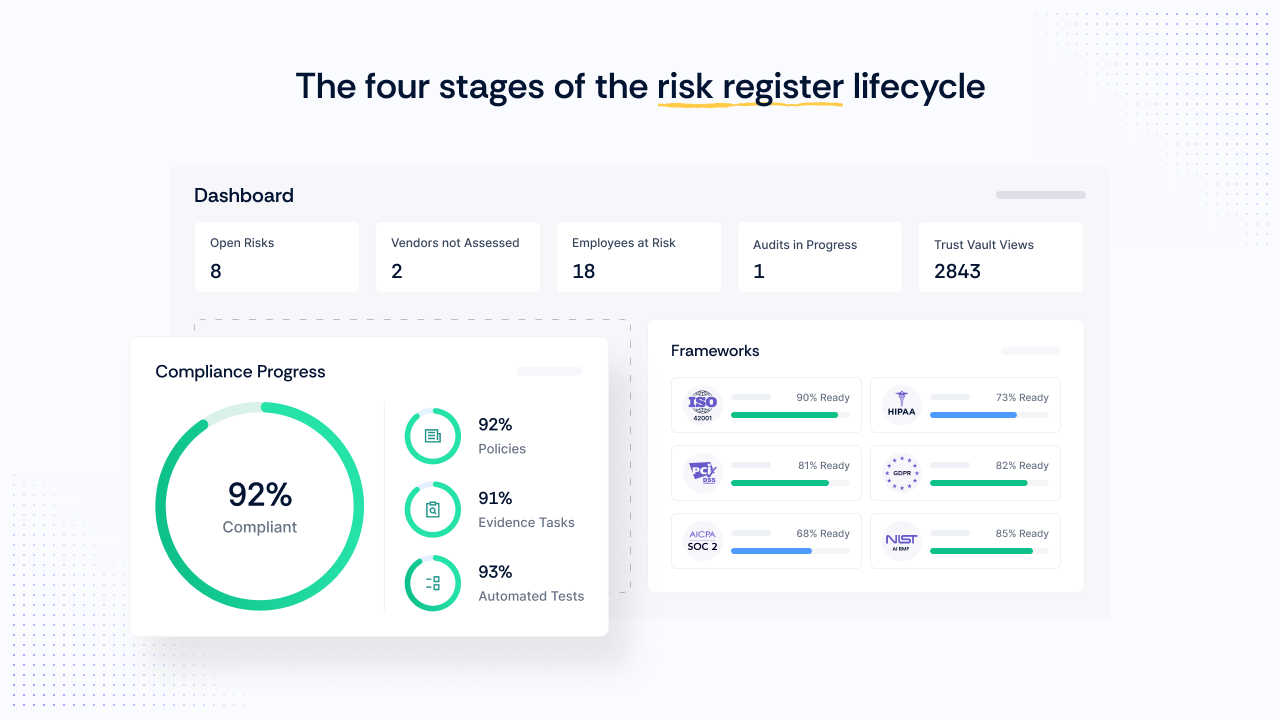
Scrut is an all-in-one GRC platform built for cloud-native, growing, and mid-market teams. It spans compliance, risk, and vendor management in a single product, which is what lets teams retire the spreadsheet-driven process and run everything, from monitoring to the auditor portal, in one place.
In practice, that means your team monitors controls, manages risk, and runs auditor collaboration from one place, without maintaining a parallel spreadsheet process alongside it.
Key features and benefits
- Continuous controls monitoring and testing: Scrut runs daily automated tests across your cloud infrastructure against 230+ CIS benchmarks. Track control effectiveness in real time, catch misconfigurations, assign remediation, and alert the right owners. This is the backbone of continuous compliance monitoring.
- Policy templates with an in-line editor: Use Scrut's library of 100+ pre-built policy templates, vetted with infosec-team support, with version control and an in-line editor. Policies map automatically to relevant controls across frameworks, which streamlines cross-framework prep.
- Agentic AI with Scrut Teammates: Detects evidence gaps before auditors see them, maps policy documents to the controls they satisfy, and generates the configuration fix in Terraform, AWS CLI, or CloudFormation format, rather than just raising an alert.
- Native DAST: Scrut DAST provides dynamic application security testing with CVSS severity scoring and external-ready PDF reports, so you do not need a separate scanning tool for that layer.
- Automated evidence extraction: Connect Scrut to your HRIS, IT, and cloud tools to automatically collect, map, and centralize evidence. Scrut automates up to 70% of evidence collection and keeps it current.
- Multi-framework support: Scrut supports 70+ compliance frameworks out of the box, plus custom frameworks at no additional cost. You can run multiple audits in parallel on pre-mapped unified controls.
- Audit management: Scrut's audit center provides a centralized dashboard, access-based views, and request and findings trackers to streamline auditor collaboration, plus automated report generation.
- Risk register and vendor risk management: Manage internal, vendor, and cloud risk from a single register, with custom scoring formulas (CIA triad, Risk Priority Number, or org-defined), heat maps, and automated mitigation workflows.
- Trust Portal and security questionnaires: A customer-facing Trust Portal serves security documentation on demand, and Scrut automates unlimited security questionnaire responses using your existing evidence.
Pros
- Hands-on support from onboarding through audit, by experts with decades of combined InfoSec experience.
- Open to customization and integration requests.
- Visual, real-time, drill-down dashboards across every module.
Cons
- Scrut complements, but does not replace, your entire security stack. It is best used alongside your existing security-only tools.
Pricing
Scrut ships single, transparent pricing: all modules included, no add-on fees for auditors or pen-testers, and no extra charge for up to 5,000 users. Contact the team for a quote or a demo.
2. Vanta
Vanta is a trust management and compliance automation platform, founded in 2017, that helps teams manage compliance and prepare for audits across frameworks like SOC 2, ISO 27001, HIPAA, and GDPR. It positions itself as the "#1 Agentic Trust Platform."
Key features
- Real-time insights: Automated evidence collection across 400+ integrations, including GitHub, Google Workspace, and AWS.
- Customizable policy templates: Pre-built policies and a policy builder for internal compliance policies.
- Audit management: Centralized evidence to demonstrate audit readiness and collaborate with auditors.
- VantaGov: A dedicated offering for FedRAMP.
- AI Governance from Vanta: An AI governance product Vanta launched in July 2026.
If you are weighing a move from your current tool, this guide on switching compliance tools walks you through the migration.
Pros
- Integration breadth is a genuine strength. With 400+ connectors covering GitHub, Google Workspace, and AWS, most teams can get continuous monitoring running without custom work.
Cons
- Known limitation: encryption-status tracking issues on Linux machines.
Pricing
Vanta offers tiered plans for startups and enterprise GRC teams. Visit vanta.com for current pricing and to request a demo.
3. Drata
Drata is a compliance automation platform that positions itself as "The Agentic Trust Management Platform." It helps teams continuously monitor controls, gather evidence through integrations, and track compliance status in real time.
Drata is a strong fit for teams that need one framework and up to 50 FTEs to start. The Foundation tier is built for that. If you are already multi-framework or growing fast, you will be on Advanced or Enterprise pricing from day one.
Key features
- Policy and control libraries: Pre-built, customizable policies and controls.
- 50+ frameworks: SOC 2, ISO 27001, GDPR, HIPAA, ISO 42001, DORA, FedRAMP, CMMC, and Cyber Essentials.
- Audit Hub: Brings auditors directly into the platform for sampling and requests.
- AI Questionnaire Assistance: Included across all tiers.
- AI Agent Governance: Launched June 2026 for AI system compliance, with AIUC-1 support added in July 2026.
If Drata is on your shortlist, it is worth reviewing the Drata alternatives too.
Pros
- User-friendly platform with strong customer support.
Cons
- The Foundation tier caps you at 1 framework and 50 FTEs. Teams that grow past that or need a second framework will need to upgrade, and custom frameworks cost extra at every tier.
Pricing
Drata offers Foundation (1 framework, up to 50 FTEs), Advanced, and Enterprise tiers. Pricing is not listed publicly; see drata.com/plans.
4. Sprinto
Sprinto is a compliance automation platform for cloud companies that describes itself as the "World's first Autonomous Trust Platform." Its core model is automated control verification: connect your cloud apps, and Sprinto maps identified risks to controls and runs tests without manual evidence chasing.
Key features
- Automated compliance workflows: Reduce the manual work of becoming audit-ready with automated control verification and gap mitigation.
- Fix-it Agent: Auto-remediation across monitors.
- AI Governance: A core product area covering ISO 42001, NIST AI RMF, and the EU AI Act.
- Multi-framework support: 200+ frameworks digitized and 25+ automated.
Sprinto serves 3,000+ customers across 75 countries. For a broader view of the category, see our roundup of the best compliance automation software.
Pros
- Automated control verification runs without manual evidence chasing. Connect your cloud apps and Sprinto maps risks to controls and tests them on a schedule.
Cons
- May require more customization to fit unique business needs.
Pricing
Sprinto offers Foundation and Growth tiers, with enterprise add-ons for Risk, TPRM, and AI Governance. Contact Sprinto for custom pricing and a demo.
5. OneTrust
If you migrated from ZenGRC, you are already on OneTrust. The product was rebranded when OneTrust acquired Reciprocity. For everyone else: OneTrust is a privacy-first GRC and trust intelligence platform that spans privacy, governance, risk, compliance, ethics, and ESG, with particularly deep data discovery, consent management, and DPIA tooling. It serves 14,000+ customers.
Key features
- Framework coverage: 100+ frameworks, including GDPR, CCPA, LGPD, PIPEDA, ISO 27001, SOC 2, HIPAA, ISO 42001, and NIST CSF.
- Out-of-the-box templates: Policy, control, and audit templates across many frameworks.
- Automated evidence collection and mapping: Pulls evidence from connected business systems and maps it to control requirements automatically. Useful for teams managing GDPR, HIPAA, and ISO 27001 in parallel, where manual tagging across frameworks becomes a bottleneck.
For a wider look at the category, see our guide to GRC solutions.
Pros
- Supports many frameworks and offers robust data privacy management tools.
Cons
- Steep learning curve and technical know-how required to deploy integrations.
Pricing
OneTrust uses modular licensing by product area (Privacy, GRC, Ethics, Data Governance). Contact OneTrust for a pricing quote and demo.
6. Optro (formerly AuditBoard)
AuditBoard rebranded to Optro in March 2026. Optro is an enterprise GRC and connected-risk platform that describes itself as an "agentic system of action" across audit, risk, InfoSec, and compliance. If your team has outgrown a startup-focused tool and needs enterprise connected-risk depth, Optro sits at that end of the market.
Key features
- Automated compliance tasks: Automates evidence collection, gap assessments, and remediation recommendations across frameworks.
- Automated mapping: Suggests mappings for risks, controls, and requirements.
- Audit reporting: Fixed and real-time audit reports with customization.
- Framework coverage: SOC 2, ISO 2700x, NIST, CMMC, and PCI DSS, plus custom frameworks.
Optro is trusted by more than 50% of the Fortune 500, was named a Gartner Magic Quadrant Leader in 2025, and acquired FairNow to add AI governance capabilities.
If you are comparing enterprise options, see our list of AuditBoard alternatives.
Pros
- Easy-to-use interface with intuitive workflows.
Cons
- Modules are often licensed separately, which can raise total implementation cost.
Pricing
Custom pricing and a demo are available on request.
7. Hyperproof
Hyperproof is a compliance operations hub built for mid-market GRC programs, letting you manage compliance across multiple frameworks from one place. If your last tool required a sprint to configure and still needed engineering support every time a new framework was added, Hyperproof's no-code setup is worth evaluating.
Key features
- Evidence collection and reuse: Hypersync enables cross-framework evidence sharing and control reuse across 70+ integrations.
- No-code workflow builder: Build and adjust workflows without engineering support.
- Risk mitigation workflows: Assign work with auto-suggested remediation and link risks to controls.
- Framework coverage: 70+ frameworks.
If Hyperproof is on your list, it is worth reviewing the Hyperproof alternatives as well.
Pros
- Easy to implement without engineering support, and the no-code workflow builder means compliance operations staff can adjust processes without opening a ticket.
Cons
- Hypersync has limitations on the proof types it can collect automatically for continuous monitoring.
Pricing
Hyperproof offers per-user tiers (Starter, Professional, Business). Pricing is not published publicly; contact their team for a quote.
How to choose the right compliance management software
A feature list does not tell you which tool fits your program. The right choice depends on where your compliance obligations are heading, how your stack is built, and how your auditor works.
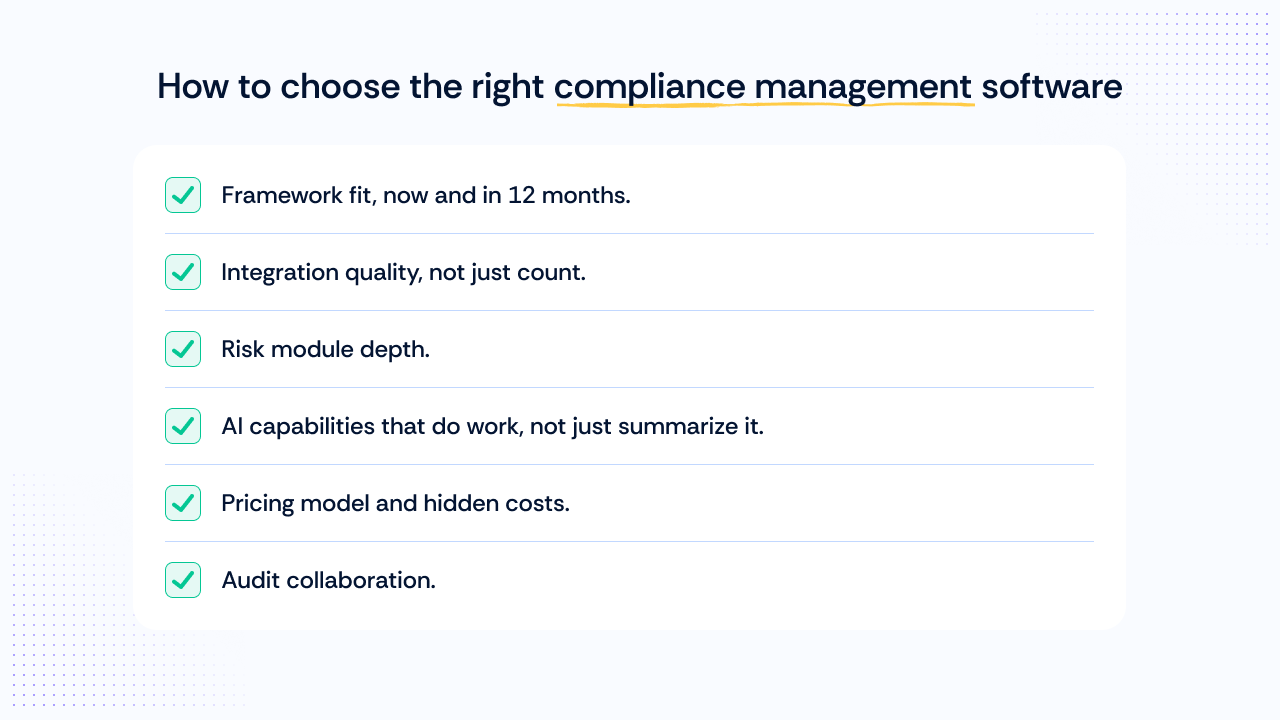
Use the six criteria below to evaluate any platform, and take the demo questions in the table straight into your vendor calls.
1. Framework fit, now and in 12 months.
Start with the frameworks you need today, then add the ones your roadmap will force on you. A company selling into healthcare will need HIPAA; one expanding into the EU will face GDPR and possibly DORA.
Confirm which frameworks are included by default and which require an add-on or a custom build. A platform that charges extra for every new framework gets expensive fast as your program grows. For a deeper walkthrough, see how to choose GRC software.
2. Integration quality, not just count.
A 400-connector marketing number means little if the integrations you actually depend on are read-only or break without warning. Ask which integrations are deep and bidirectional versus surface-level, and what happens operationally when one fails.
3. Risk module depth.
Compliance and risk are one muscle, not two. A capable risk module gives you a structured register with customizable scoring, CIA triad, Risk Priority Number, or an org-defined formula, and native third-party risk built in, not bolted on. If risk is a thin bolt-on, you will end up running it in a spreadsheet anyway, which defeats the point.
4. AI capabilities that do work, not just summarize it.
Most platforms now have an AI story. The question is whether the AI closes the loop or just opens a ticket. Evidence gap detection, questionnaire drafting, and policy-to-control mapping are the three capabilities worth verifying in a demo. Ask the vendor to show you a completed task, not a screenshot of an alert.
5. Pricing model and hidden costs.
Per-user pricing and all-inclusive pricing behave very differently as you scale. Ask directly whether auditors, pen-testers, and additional frameworks are charged separately. A low headline price with per-seat auditor fees and per-framework add-ons can quietly become an expensive program.
6. Audit collaboration.
Your platform should support your auditor's workflow, not fight it. If auditors have to work outside the tool in email and spreadsheets, you lose the time the platform was supposed to save. Confirm the platform offers auditor-native collaboration (requests, sampling, findings) inside the product. A clear GRC implementation roadmap helps you sequence this alongside rollout.
Questions to ask in a vendor demo
Eliminate compliance hassles with Scrut's automated compliance management
Most teams come to this decision with one problem: managing multi-framework compliance without burning out a small team. Manual, spreadsheet-driven processes do not scale with that, and they create exactly the missed risks, failed audits, and last-minute scrambles you are trying to avoid.
That is where Scrut's model differs: the platform handles the automation, and a team of security and compliance experts makes the judgment calls your team doesn't have bandwidth for.
Scrut is built for deep customization rather than a one-size-fits-all checklist, because a startup's compliance journey looks nothing like a mid-market company's. Many customers also report a lower total cost of ownership than other platforms, particularly SaaS companies.
If you want to stay ahead of where the market is heading, our take on GRC trends is a useful next read, or dive deeper into compliance automation and how it works in practice.
Book a demo to see Scrut's compliance automation platform in action.
Compliance management software helps organizations manage regulatory and security requirements in a structured way. It centralizes policies, controls, risk registers, evidence collection, and audit workflows, enabling teams to track compliance with standards such as SOC 2, ISO 27001, PCI DSS, and GDPR without relying on manual processes.
Compliance management software is commonly used by security teams, compliance managers, risk teams, and IT leaders. It is particularly valuable for growing companies that need to manage multiple frameworks, prepare for audits, and maintain continuous compliance without adding significant operational overhead.
Most platforms automate evidence collection, maintain an organized repository of compliance documentation, and track the implementation of controls across systems. This makes it easier to share evidence with auditors, reduces back-and-forth during audit reviews, and shortens audit preparation timelines.
Key features typically include automated evidence collection, control mapping across frameworks, policy management, vendor risk management, risk tracking, audit readiness dashboards, and integrations with cloud services and security tools.
Yes. Most modern platforms allow organizations to manage multiple compliance requirements simultaneously. Controls can often be mapped across frameworks, allowing teams to reuse evidence and reduce duplicate work when working toward certifications such as SOC 2, ISO 27001, HIPAA, or PCI DSS.


%201.png)