%201.png)
Choose risk-first compliance that’s always on, built for you.


For any organization that stores, processes, or transmits customer data, a SOC 2 compliance audit is one of the most consequential steps toward demonstrating that trust is not just claimed but verified. Once you provide the SOC 2 certification to your clients, they experience a sense of enhanced trust, transparency, and reliability in your organization. It also acts as insurance for several organizations when faced with data breaches.
Even though there are plenty of benefits, let’s not forget that completing the SOC 2 audit is incredibly time-consuming and requires considerable resources. This holds true, especially if your organization is pursuing a SOC 2 compliance audit for the first time.
That brings us to the question: How can your organization streamline the audit process?
In this comprehensive guide, we will delve into the keys to successful SOC 2 audits, empowering you to navigate the intricacies of this vital process with finesse.
Quick definition: A SOC 2 compliance audit is an independent examination conducted by a licensed CPA firm that evaluates whether an organization’s internal controls meet the AICPA’s Trust Services Criteria (TSC) for security, availability, processing integrity, confidentiality, and privacy.
The audit results in a formal SOC 2 report, either Type 1 (a point-in-time design assessment) or Type 2 (an assessment of operating effectiveness over 6 to 12 months), that organizations share with customers and prospects to demonstrate their security posture.
Before we delve into the nuances, let us briefly review the essence of SOC 2 compliance. The main objective of SOC 2 audits is to assess an organization’s internal controls for data security, availability, processing integrity, confidentiality, and privacy.
In contrast to SOC 1, which focuses on financial controls, SOC 2 offers an assurance framework for operational controls. Because of this, it is the preferred certification for businesses that handle sensitive customer data.
What is a SOC 2 audit based on? SOC 2 audits are based on the American Institute of CPAs (AICPA) Trust Services Criteria and focus on operational controls related to the five core principles: security (also known as the common criteria), availability, processing integrity, confidentiality, and privacy.
Organizations seeking SOC 2 compliance aim to demonstrate to their clients and stakeholders that their systems and processes effectively safeguard sensitive data.
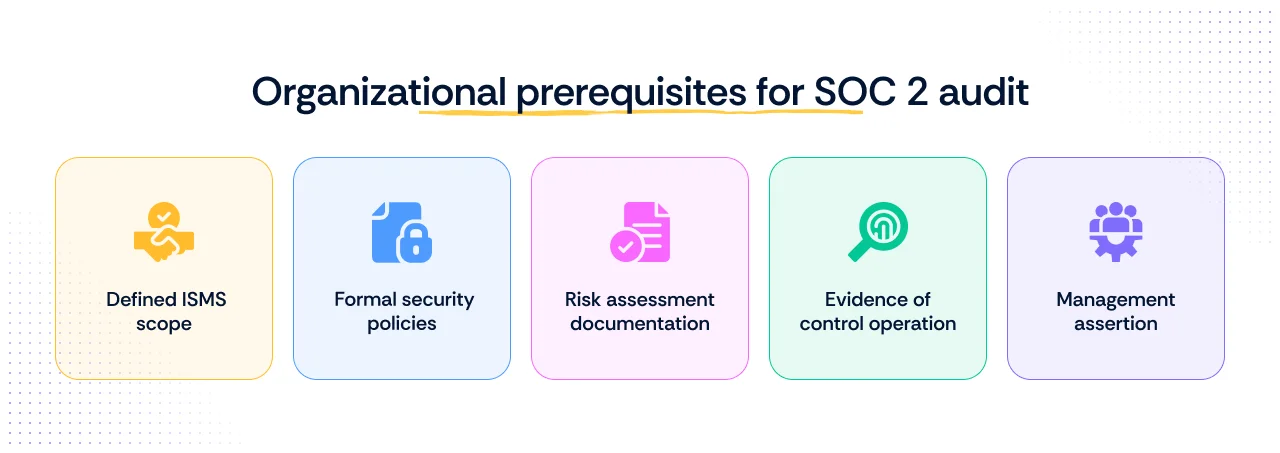
Before engaging an auditor, your organization needs to satisfy several baseline requirements. Meeting these upfront dramatically reduces audit preparation time and the risk of a qualified opinion.
Not every organization is ready to walk into a SOC 2 compliance audit on day one. Before you engage an auditor, these are the foundational elements that must already be in place.
You must document which systems, services, and data are in scope for the audit. This means identifying every system component that supports your service delivery, including cloud infrastructure, internal tools, third-party integrations, and the personnel who interact with them.
A poorly defined scope is one of the most common reasons audits run over time and budget. Too broad, and you create an unnecessary evidence burden. Too narrow, and you risk a qualified opinion if the auditor determines that critical systems were excluded. Getting scope right before day one is non-negotiable.
Written, management-approved policies are a prerequisite, not a deliverable you produce during the audit. Policies must cover access control, incident response, change management, and data classification at a minimum. Each policy should specify ownership, review frequency, and version history.
Auditors will ask for evidence that these policies exist, that they have been approved by leadership, and that employees have acknowledged them. Policies that exist only in draft or have not been formally ratified will not satisfy TSC requirements.
A formal risk assessment aligned to CC3.1 is required. This is not an informal threat brainstorm. The assessment must identify risks to the confidentiality, integrity, and availability of your systems, assign likelihood and impact ratings, and document how each risk is treated, whether mitigated, accepted, transferred, or avoided.
For Type 2 audits, auditors will also look for evidence that this assessment is reviewed and updated on a regular cadence, not produced once and filed away.
For Type 2 audits, controls must operate for a minimum observation period, typically six to twelve months. This means your controls need to be running and generating evidence well before the audit fieldwork begins.
Organizations that implement controls close to the audit window often find themselves without sufficient evidence to demonstrate consistent operation. Start your observation period early and establish automated or systematic evidence collection wherever possible to reduce the manual burden during the audit.
Leadership must formally assert that the controls and system descriptions included in the SOC 2 report are fairly presented. This is a signed statement from management, typically from the CEO, CTO, or equivalent, and it carries legal weight. It is not a formality.
Auditors treat the management assertion as the foundation of the engagement. Organizations should involve legal counsel when drafting this assertion to ensure accuracy and alignment with the system description prepared for the report.
Tracking audit readiness across multiple workstreams is easy to lose control of. Use this checklist to confirm your organization has covered the essentials at each stage of the SOC 2 compliance audit process.
Not every security professional or consulting firm can conduct a SOC 2 compliance audit. Only independent CPA firms licensed by the AICPA are authorized to issue SOC 2 reports. This is a hard requirement, not a best practice.
Understanding who can perform the audit and what separates a strong auditor from a merely qualified one directly affects how smooth and credible your audit will be.
Organizations often work with two distinct types of firms during a SOC 2 engagement, and confusing their roles creates problems later.
Readiness consultants help organizations prepare for the audit. They identify control gaps, assist with policy development, map controls to TSCs, and guide evidence collection. Their job is to get you audit-ready. They are not, however, authorized to issue SOC 2 reports.
Only AICPA-licensed CPA firms can perform the official audit and produce the SOC 2 report. Engaging a readiness consultant does not satisfy this requirement. Some organizations work with a consultant first, then engage a separate CPA firm for the formal audit.
Others work directly with an audit firm that also offers readiness advisory services. Either approach is valid, provided the issuing firm meets AICPA licensure requirements.
The timeline for a SOC 2 compliance audit varies significantly depending on whether you are pursuing a Type 1 or Type 2 report, the maturity of your existing controls, and the complexity of your audit scope. The table below breaks down realistic timelines across each phase of the engagement.
SOC 2 reports are valid for 12 months from the date of issuance. Organizations that complete a Type 1 first often use it as a foundation to move directly into a Type 2 observation period, keeping compliance efforts continuous and reducing the total time to full Type 2 certification.
Even well-prepared organizations encounter slowdowns. The most common causes are predictable, which means they are also preventable.
Disorganized evidence is the single biggest source of audit delays. When evidence is scattered across drives, inboxes, and spreadsheets, the retrieval process consumes weeks that could be spent on substantive review. Auditors request evidence on a tight schedule, and gaps in response time extend fieldwork considerably.
Late-discovered control gaps surface when organizations skip or rush the readiness phase. Finding a missing control two weeks before fieldwork begins leaves little room to remediate, document, and demonstrate operation before the auditor arrives.
A large audit scope amplifies every other risk. Organizations that include too many systems and services in their first audit often struggle to collect sufficient evidence across all in-scope components within the observation window.
First-time audit complexity affects organizations that are new to SOC 2. Without prior experience, teams underestimate evidence volume, misjudge policy review timelines, and take longer to respond to auditor requests. Each of these adds time.
Manual audit preparation compounds every delay listed above. Platforms like Scrut are designed to remove the bottlenecks that slow teams down at every phase of the SOC 2 compliance audit process.
Scrut automates evidence collection across your cloud infrastructure, SaaS tools, and internal systems, pulling audit-ready evidence continuously rather than requiring a manual scramble before fieldwork.
Controls are monitored in real time, so gaps surface weeks before the auditor arrives rather than during fieldwork. This continuous visibility removes the element of surprise that derails so many first-time audits.
The reduction in manual effort is significant. Teams that previously spent weeks gathering screenshots, access logs, and policy acknowledgments can redirect that time toward remediation and stakeholder alignment. The result is a materially shorter audit cycle and a stronger evidence package when fieldwork begins.
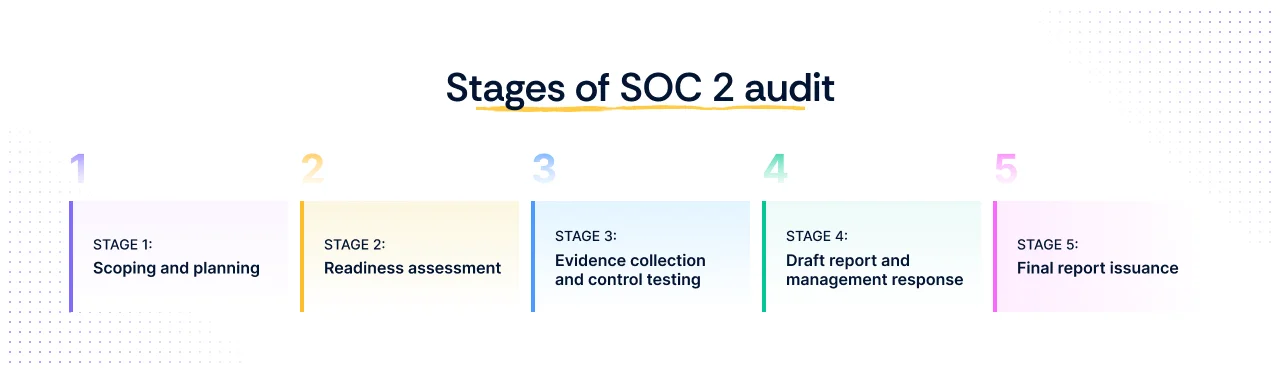
A SOC 2 compliance audit does not begin the moment an auditor walks in. It unfolds across five distinct stages, each with its own deliverables, decisions, and dependencies. Understanding what happens at each stage helps organizations allocate resources accurately and avoid the reactive scrambles that stretch timelines.
Everything in a SOC 2 compliance audit flows from how well you define the scope upfront. This stage establishes the boundaries of the entire engagement.
Scope definition involves identifying every system, service, and infrastructure component that supports your service delivery and will be subject to auditor review. Decisions made here determine the volume of evidence required, the number of controls to implement, and the overall cost of the audit.
TSC selection follows the scope. Security (CC series) is mandatory for every SOC 2 audit. Additional criteria, including availability, processing integrity, confidentiality, and privacy, are selected based on your service commitments and what your customers expect you to demonstrate.
The audit window is established in collaboration with your auditor. For Type 1, this is a single point in time. For Type 2, it is a defined period, typically three, six, or twelve months, during which your controls must operate and generate evidence.
The system description is a formal document that describes your service, the boundaries of the system, the controls in place, and any complementary user entity controls (CUECs) or subservice organizations. It forms the basis of the final SOC 2 report and must be accurate and complete before fieldwork begins.
A readiness assessment is the closest thing to a rehearsal before the formal audit. Its purpose is to surface gaps before the auditor does.
The gap assessment compares your current control environment against the TSCs you have selected. It identifies controls that are missing, partially implemented, or not generating sufficient evidence. The output is a prioritized remediation list that guides preparation work in the weeks before fieldwork.
Mock audits simulate the procedures an external auditor will follow. Internal teams or readiness consultants walk through the same evidence requests, control walkthroughs, and interviews that will occur during formal fieldwork.
This process reveals weaknesses in documentation, inconsistencies in control operations, and personnel who are unfamiliar with audit procedures. Identifying weaknesses early is the primary value of this stage.
A control gap found six weeks before fieldwork can be remediated and documented. The same gap found during fieldwork becomes an exception in the auditor’s report, which is a materially worse outcome for the organization and for customer confidence.
This is the core of the audit engagement. The auditor examines your controls through multiple lenses to determine whether they are designed appropriately and operating effectively.
Documentation reviews involve the auditor examining your policies, procedures, system descriptions, risk assessments, and configuration records. Incomplete or outdated documentation raises questions about whether controls exist in practice or only on paper.
Interviews are conducted with personnel across IT, security, operations, and leadership. Auditors use these conversations to verify that the people responsible for controls understand them and can speak to how they operate. Inconsistencies between documentation and what personnel describe in interviews are a common source of exceptions.
Technical testing involves the auditor directly examining system configurations, access controls, log settings, encryption implementations, and other technical controls. This may include pulling sample data from production systems to verify that controls operated as described during the audit period.
The difference between Type 1 and Type 2 is most visible at this stage. In a Type 1 audit, the auditor assesses whether controls are suitably designed at a point in time. Evidence requirements are narrower. In a Type 2 audit, the auditor evaluates whether controls operated effectively across the entire observation period.
This requires a significantly larger evidence set, including logs, access review records, incident reports, change tickets, and training acknowledgments covering the full audit window.
Before the final report is issued, the auditor produces a draft that details findings, exceptions, and observations. This stage gives organizations an opportunity to review and respond before the report is finalized.
Draft findings describe any instances where the auditor determined that a control was not suitably designed or did not operate effectively. Each finding is supported by specific evidence or the absence of it.
Exception handling is the process by which the organization reviews each draft finding, confirms its accuracy, and decides how to respond. Organizations should resist the temptation to dispute findings on procedural grounds rather than substantive ones. Auditors are experienced at distinguishing between genuine disagreements and attempts to minimize documented gaps.
Corrective actions are documented in the management response section of the report. This section allows organizations to formally describe the steps they have taken or plan to take to address each exception.
A well-written management response demonstrates accountability and gives prospective customers context when evaluating the report. It does not remove the exception, but it does meaningfully influence how the report is received.
Once the management response has been incorporated and the auditor is satisfied with the final document, the SOC 2 report is issued.
The final SOC 2 report includes the auditor's opinion, the system description, the description of controls, the results of testing, and the management response. For Type 2 reports, it also includes the observation period and an assessment of whether controls operated effectively throughout.
The NDA sharing process governs how the report is distributed. SOC 2 reports are confidential documents and are typically shared with customers, prospects, and partners under a non-disclosure agreement.
Organizations should establish a standard NDA template and a controlled distribution process before the report is issued to avoid informal or unprotected sharing.
Customer and vendor use cases are the primary reason most organizations pursue SOC 2 in the first place. Enterprise customers use the report to fulfill their own vendor due diligence requirements. Prospects use it to evaluate security posture during procurement.
Existing vendors and partners may require an updated report annually as a condition of continued engagement. Having a current SOC 2 report on hand removes friction from all of these conversations.
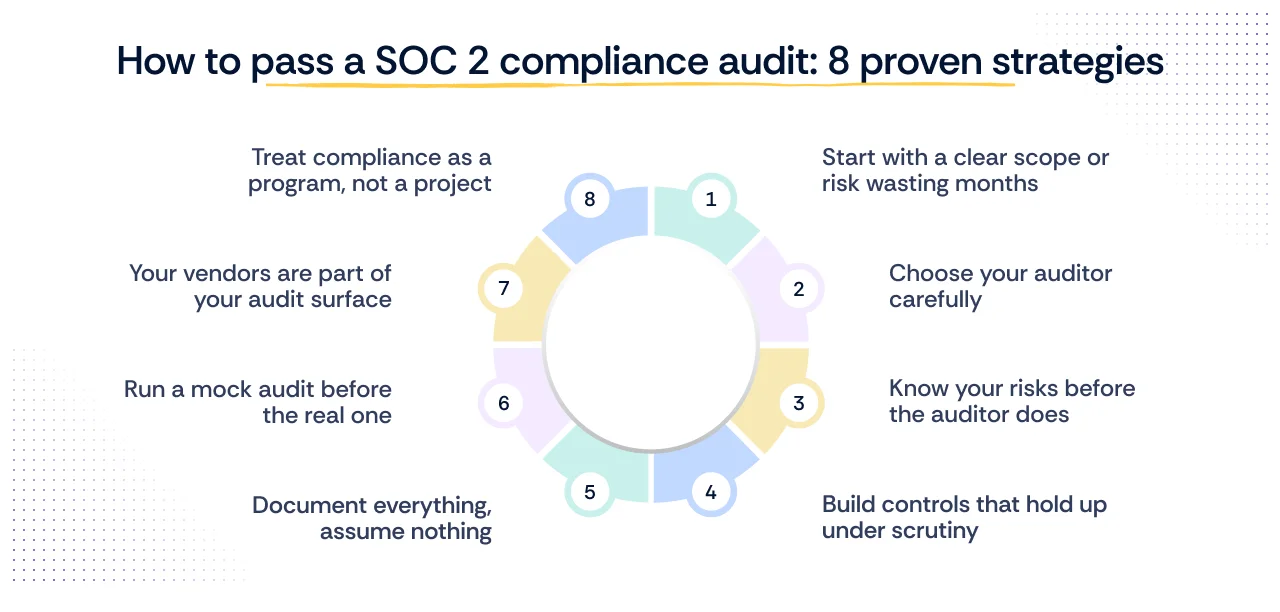
What is a SOC 2 audit’s success dependent on? Well, there are 8 key factors that influence the success of a SOC 2 audit.
The foundation of a successful SOC 2 audit lies in precisely defining the SOC 2 audit scope and objectives. Organizations must articulate the specific goals they wish to achieve through the audit and identify the systems, processes, and data that will be subject to evaluation.
A clear and well-defined scope and a SOC 2 audit checklist will ensure that the audit remains focused, relevant, and aligned with the organization's overall objectives.
During this stage, communication between the audit team and key stakeholders is critical. Understanding the organization's business goals and customer expectations allows the audit team to tailor their assessment accordingly.
Additionally, establishing a comprehensive scope helps prevent unnecessary deviations during the audit process, saving time and resources.
One of the most important decisions to make before jumping into a SOC 2 audit is deciding which type of SOC 2 report is fit for your organization, depending on the resources and time assigned to the project.
Understanding where SOC 2 sits within the broader SOC framework helps organizations make an informed decision about which report their business actually needs.
SOC 2 is based on five trust service criteria (TSCs). As a part of the guidelines underlying the SOC 2 audit, the selection of one of the five TSCs is necessary.
However, you do not have to address all five to be SOC 2 compliant. Except for security, which must be mandatory in every SOC 2 audit, the rest are entirely optional. You can decide which of the remaining TSCs fit your organization's objectives and pursue them accordingly.
However, in order to expedite your first SOC 2 audit, you may decide to limit the number of criteria and then address them during subsequent audits.
Timelines are very critical for organizations, and this case is no different. Typically, a SOC 2 Type 1 audit takes one to three months, while an audit for SOC 2 Type 2 can take six to twelve months or more.
The SOC 2 audit process doesn’t have built-in deadlines, so if you don’t create and follow a timeline on your own, it might take you forever to complete the report. You can divide the milestones into categories and create a stipulated timeline to ensure everyone involved follows it.
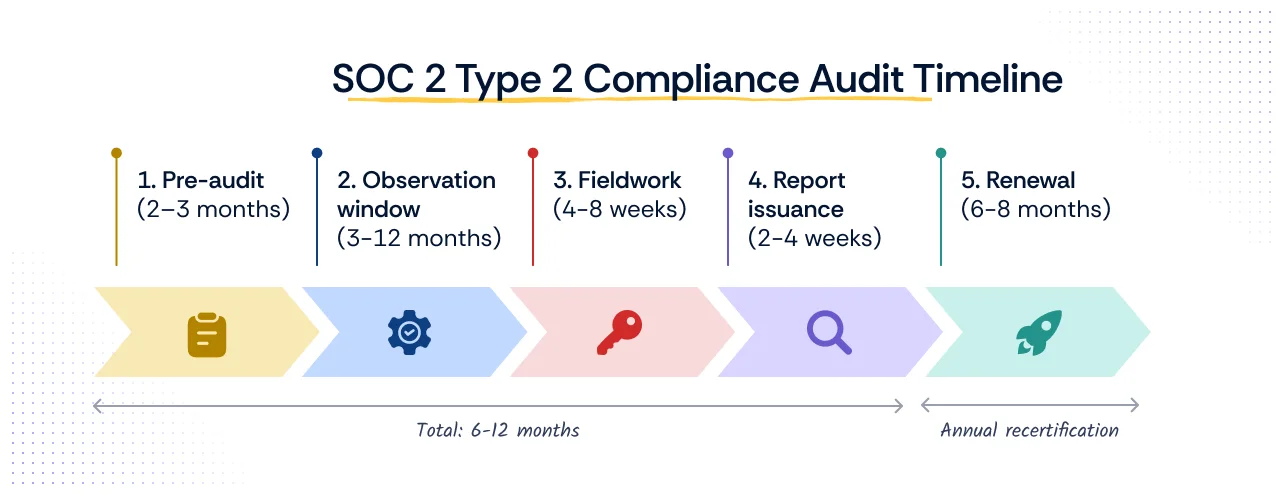
Once you’ve determined which type of SOC 2 audit is right for your organization, the next key step is finding the right SOC 2 auditor.
Thinking that finding an auditor for a SOC 2 compliance audit is easy turns out to be one of the biggest mistakes organizations often make.
As per the AICPA, your SOC 2 audit must be conducted by an independent Certified Public Accountant. Certified Information System Auditor (CISA) and Certified Information System Security Professional (CISSP) are some credentials you can check while selecting a CPA firm for your organization.
A CPA firm with these licenses will better understand the SOC 2 auditing framework. It can also help you with strategies regarding security risk management.
The success of a SOC 2 audit hinges on assembling a competent and knowledgeable audit team. These professionals should possess expertise in information security, IT governance, risk management, and compliance.
Ideally, the team should include certified information security experts, Certified Information Systems Auditors (CISAs), and Certified Public Accountants (CPAs) with experience in SOC 2 audits.
Assigning specific roles and responsibilities to team members ensures a coordinated effort throughout the audit. The team should work closely with key stakeholders, such as IT personnel, data custodians, and business leaders. This will help them gain a comprehensive understanding of the organization’s operations, IT infrastructure, and risk landscape.
A robust risk assessment is at the core of SOC 2 compliance. During this phase, the audit team identifies potential risks and vulnerabilities that could impact the achievement of the audit objectives.
Risk assessment methodologies, such as the ISO 31000 standard, can be utilized to systematically identify, analyze, and evaluate risks.
By identifying and prioritizing risks, organizations can develop effective risk mitigation strategies. The risk assessment should consider both internal and external factors, such as system vulnerabilities, data breaches, natural disasters, and emerging cybersecurity threats.
Understanding the significance of risks allows organizations to allocate resources more efficiently to mitigate the most critical risks first.
SOC 2 compliance requires organizations to implement strong internal controls. These controls address the five core principles: security, availability, processing integrity, confidentiality, and privacy.
These controls serve as the backbone of an organization’s security and privacy framework. They are essential to protecting sensitive data and ensuring uninterrupted service availability.
Implementing internal controls involves designing and deploying policies, procedures, and technical measures to safeguard data and infrastructure.
Examples of internal controls include access controls, data encryption, firewalls, intrusion detection systems, data classification, and personnel training programs.
One of the biggest challenges or pain points while pursuing a SOC 2 audit is the implementation of security controls. This is exactly why your organization must prepare for it beforehand.
With dozens of controls covering ten essential security dimensions, it’s easy for businesses to find themselves wasting a lot of time trying to decide which controls to pick and exactly what they should do to demonstrate their readiness.
It doesn’t help that there is very little guidance on which controls to focus on and why. Ensure that you are using expert guidance or streamlining the implementation of security controls with the help of a pre-built policy library.
Comprehensive documentation is fundamental in SOC 2 audits. Organizations must maintain clear and organized records of all relevant controls, policies, and procedures related to the five core principles.
Well-documented policies and procedures demonstrate the organization’s commitment to data security and compliance and facilitate the audit process.
Documentation should include information on the design and implementation of internal controls, as well as evidence of their effectiveness. Auditors rely on this documentation to verify that controls are in place and operating effectively.
Regularly updating documentation to reflect changes in the organization’s environment and operations is crucial to maintaining compliance.
Readiness assessments, also known as mock audits, offer a proactive approach to preparing for the formal SOC 2 audit.
These assessments involve conducting an internal audit, simulating the procedures and criteria that will be used during the actual audit. They provide organizations with an opportunity to identify compliance gaps and areas for improvement before the official audit begins.
During readiness assessments, the audit team can identify weaknesses in internal controls and evaluate the effectiveness of existing risk mitigation strategies. It allows organizations to fine-tune their controls, address deficiencies, and ensure alignment with SOC 2 requirements.
Moreover, readiness assessments enable organizations to familiarize their personnel with the audit process, reducing the anxiety and uncertainties associated with the official audit.
Every vendor with access to your systems or data is a potential gap in your SOC 2 compliance audit. However, third-party vendors can introduce security and compliance risks. This can directly impact an organization’s SOC 2 compliance efforts. This is why third-party risk management in SOC 2 compliance is vital.
Monitoring the security practices of third-party service providers is vital to maintaining SOC 2 compliance throughout the supply chain. Organizations must assess the compliance of vendors and establish clear contractual obligations related to data security and privacy.
Regular assessments and monitoring of third-party risks ensure that the organization’s data remains protected and in compliance with SOC 2 requirements.
Vendors can sometimes play an important role in meeting SOC 2 security requirements. For instance, if your infrastructure is housed in a third-party data center, you would expect the third party to have the necessary physical security controls in place to restrict access to your infrastructure.
To fulfill the physical security requirement for the SOC 2 audit, you would rely on the third party’s controls to function properly. Understanding what is expected of your vendor and communicating what is expected of them will allow for a more efficient audit flow.
SOC 2 compliance is not a one-time achievement but an ongoing journey of continuous improvement. Organizations must foster a culture of continuous improvement, learning from audit findings, industry best practices, and past experiences to continuously strengthen their security posture.
By implementing corrective actions and enhancements based on lessons learned, organizations demonstrate their commitment to maintaining a robust security environment.
Regularly reassessing and updating controls in response to emerging threats and challenges enables organizations to stay ahead of potential risks and vulnerabilities.
The validity of SOC 2 Type 2 reports is 12 months from the date of issuance. Any report that is older than that has less value for prospective clients.
In order to maintain the trust of clients and ensure your organization is in line with security standards in real-time, you need continuous, ongoing compliance.
Even though it is a demanding security standard, in the end, it’s very rewarding because it shows that your company upholds constant security and dependability standards.
SOC 2 and ISO 27001 are both widely recognized security frameworks, and organizations frequently encounter both during enterprise procurement and vendor due diligence. They are not the same thing, though they share meaningful common ground.
They are two sides of the same security coin: widely respected and both audit-driven, but fundamentally different in scope, structure, and geographic recognition.
Many organizations do pursue both frameworks, and for good reason. SOC 2 and ISO 27001 share significant control overlap across areas, including access control, incident response, risk assessment, and asset management.
A combined compliance strategy treats the two not as parallel workstreams but as a unified control environment, mapping requirements from both frameworks to a single set of controls from the outset.
This approach avoids duplication of effort and reduces the burden on internal teams. Rather than running two separate evidence collection exercises, organizations that plan for both simultaneously can leverage shared controls to satisfy requirements under each framework.
Automation makes this considerably more practical. Platforms like Scrut, an AI platform powered by autonomous agents that operationalize continuous compliance and security, replacing audit chaos with scalable execution, allow organizations to maintain a single control library mapped simultaneously to SOC 2 Trust Services Criteria and ISO 27001 clauses.
Evidence collected for one framework feeds the other, and control gaps surface across both simultaneously rather than being discovered separately during each audit cycle. For a full breakdown of how the two frameworks compare, see Scrut's SOC 2 vs. ISO 27001 guide.
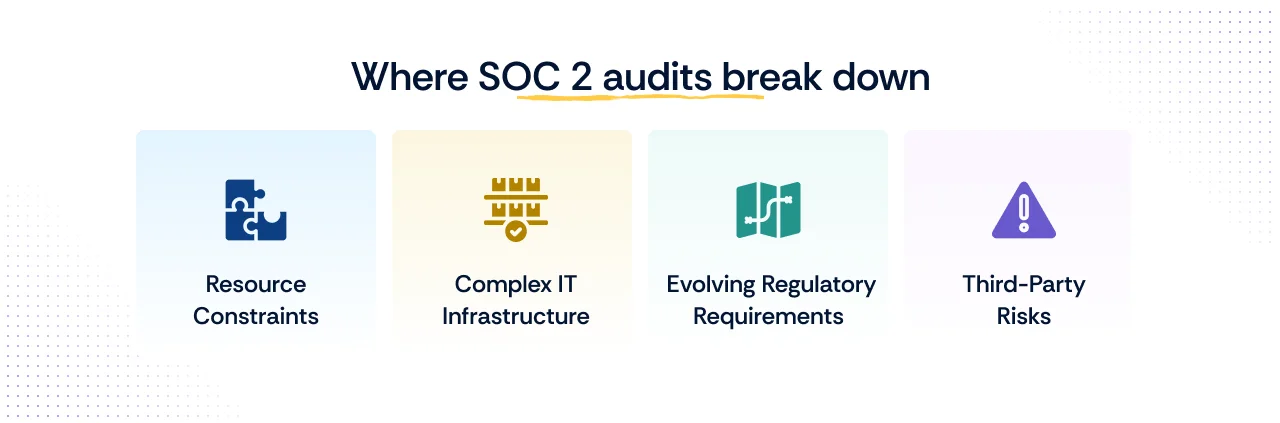
While we aspire to smooth sailing, the reality is that challenges may arise during SOC 2 audits. Overcoming challenges in SOC 2 assessments is possible with these strategies:
The Information Security team may collaborate with the CFO and other executives to highlight the potential financial and reputational losses from data breaches. They can emphasize the cost-effectiveness of investing in SOC 2 compliance to mitigate such risks, convincing leadership to allocate sufficient resources for the audit process.
Leverage your expertise to streamline processes, centralize controls, and ensure uniformity across all locations. For instance, your organization’s IT team may work with the audit team to standardize security protocols and policies across different branches and subsidiaries. They may centralize controls by implementing a cloud-based security infrastructure, simplifying the monitoring and management of security measures across all locations.
The compliance officer may proactively monitor regulatory updates and assess their impact on the organization’s SOC 2 controls. They promptly communicate relevant changes to the audit team and initiate necessary updates to policies and procedures to ensure continuous compliance.
To overcome possible third-party security threats, the vendor management team may conduct regular assessments of third-party vendors, ensuring they meet SOC 2 compliance requirements. They review and update contracts to include specific clauses related to data security and privacy, holding vendors accountable for adhering to agreed-upon standards.
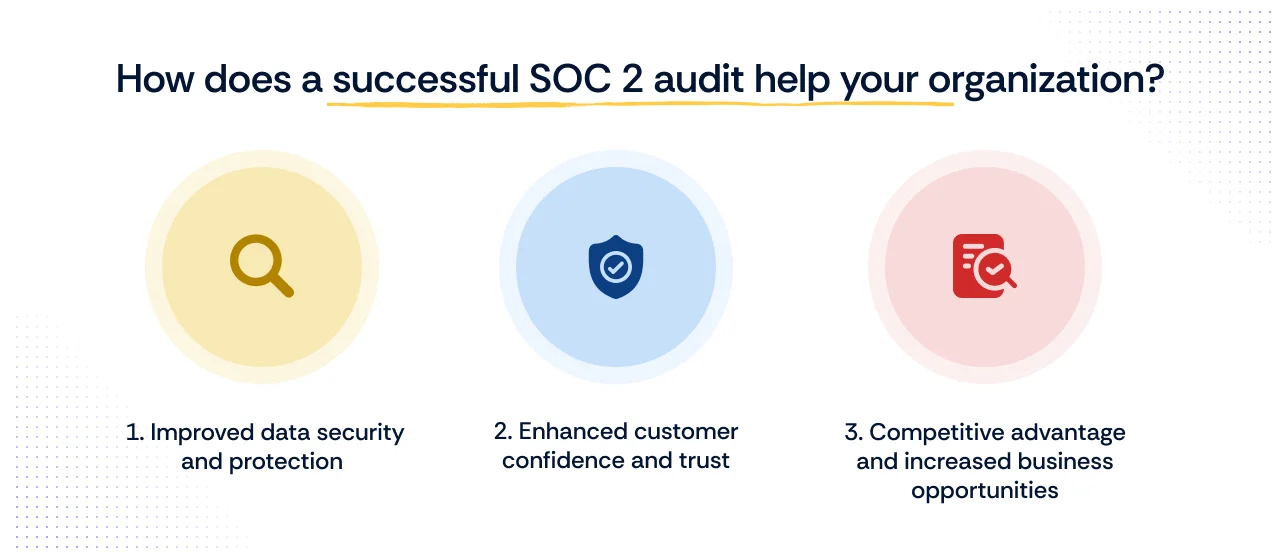
Achieving SOC 2 compliance not only safeguards sensitive data and enhances customer trust but also differentiates organizations as trustworthy and security-conscious service providers.
With a comprehensive understanding of the core principles, a competent audit team, and proactive risk management practices, organizations can confidently navigate the complexities of SOC 2 audits and ensure data security and compliance excellence.
This helps mitigate data breaches and fortify your organization’s defense against cyber threats.
A successful SOC 2 audit demonstrates your commitment to safeguarding customer data and fostering long-lasting relationships built on trust.
Stand out amidst the competition and unlock new horizons with clients and strategic partners with a successful SOC 2 audit.
A well-structured auditing process can either make or break an organization’s compliance procedures.
Equipped with the keys to SOC 2 audit success, you are now well-prepared to navigate the intricate landscape of data security and compliance with steadfast resolve.
By implementing the recommended strategies, your organization will thrive in an ever-changing world where data protection and customer trust reign supreme.
Whether you’re preparing for your first SOC 2 compliance audit or streamlining an annual recertification cycle, Scrut reduces manual effort by ~70% while keeping your controls audit-ready year-round.
Most organizations use technologically advanced platforms, like Scrut, that help streamline the compliance process and effectively reduce the resources required to complete the SOC 2 audit. Scrut is a smart and radically simple governance, risk, and compliance automation platform for growing startups and mid-market enterprises.
With Scrut, compliance teams can reduce ~70% of their manual effort in continuously maintaining compliance towards SOC 2, ISO 27001, GDPR, PCI DSS, HIPAA, and CCPA. Schedule your demo today to see how it works.
1. What is a SOC 2 audit?
The SOC 2 audit is a document that describes in detail the measures organizations have implemented in order to meet the SOC 2 standards. Depending on the success of the audit, a report is issued to reassure clients that the organization is committed and capable of safeguarding data.
2. Who performs the SOC 2 audit?
Only independent CPA firms licensed by the AICPA are authorized to perform a SOC 2 audit and issue the resulting report. Internal teams and readiness consultants can help prepare for the audit, but they cannot issue a SOC 2 report. When selecting a CPA firm, look for credentials such as CISA and CISSP, which indicate relevant IT audit and security expertise alongside the required CPA licensure.
3. What is the goal of the SOC 2 compliance audit?
The goal of the SOC 2 audit process is to demonstrate your company’s capability to safeguard private information and customer data. Security, availability, confidentiality, processing integrity, and privacy are the five Trust Services Criteria used to evaluate the objectives of your organization.
4. How much does a SOC 2 audit cost?
The cost of a SOC 2 audit varies depending on several factors. SOC 2 Type 1 audits typically cost between $15,000 and $40,000, while Type 2 audits range from $30,000 to $80,000. For enterprise organizations or those engaging a Big Four firm, costs can reach significantly higher.
The primary factors that influence final cost include audit scope, organizational complexity, the CPA firm selected, the extent of readiness consulting required prior to fieldwork, and the tooling used to automate evidence collection. Organizations that invest in compliance automation platforms generally see lower overall audit costs due to reduced manual effort and faster evidence preparation.
5. How long does a SOC 2 compliance audit take?
Timeline depends on the report type and your organization’s readiness going in. A SOC 2 Type 1 audit typically takes 3 to 6 months from the start of preparation through report issuance. A SOC 2 Type 2 audit generally takes 6 to 12 months, since auditors must observe controls operating over a defined period before fieldwork can conclude.
Organizations that begin with strong documentation, a defined scope, and automated evidence collection tend to come in closer to the lower end of these ranges.